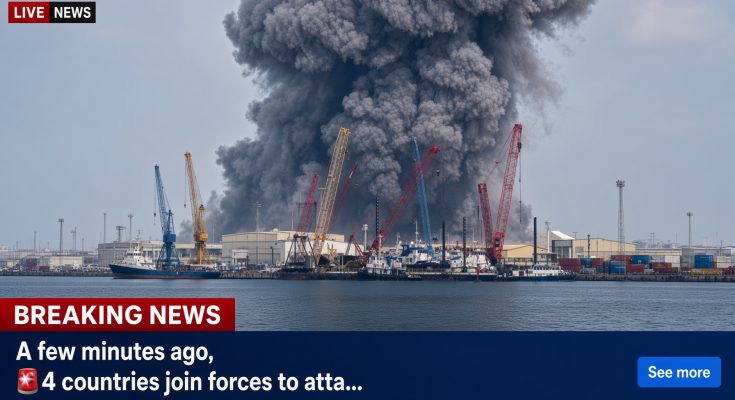
Iranian forces launched massive missile and drone strikes against U.S. military bases across the Persian Gulf, threatening critical global oil routes.
Iranian forces launched sustained waves of ballistic missiles and attack drones at key military installations hosting American personnel across the Persian Gulf, plunging the region into a volatile war footing and triggering emergency defensive postures. The coordinated strikes represent a decisive collapse of local containment, underscoring Tehran’s operational doctrine of projecting asymmetric retaliation directly into neighboring host states. Rather than absorbing kinetic exchanges within its own borders, Iran has systematically targeted the dense network of forward bases Washington maintains across Bahrain, Qatar, Kuwait, and the United Arab Emirates.
Air-defense sirens sounded across the United Arab Emirates as regional early-warning networks tracked incoming salvos. Advanced defensive systems engaged aerial targets attempting to penetrate local airspace, placing special emphasis around Al Dhafra Air Base, an indispensable hub supporting American aerial refueling and combat operations. While Iranian state media claimed precision impacts, defense authorities urged caution while awaiting verified post-strike satellite analysis.
The offensive has placed Bahrain—the nerve center of American naval operations in the Middle East—under acute operational strain. The island kingdom hosts the operational headquarters of U.S. Naval Forces Central Command and the Fifth Fleet, making it an inevitable target as Tehran expands cross-border operations. Bahraini air-defense forces actively intercepted incoming aerial threats in concert with shipboard combat systems operating in nearby waters.
Further north, Qatar’s Al Udeid Air Base faced similar pressure as a forward headquarters for U.S. Central Command. Independent commercial imagery has previously confirmed localized logistics damage, and military personnel retreated to hardened bunker complexes as interceptor missiles detonated overhead. Kuwait has likewise found its territory drawn into the missile corridor as batteries engaged projectiles targeting facilities supporting American logistics.
This synchronized multi-axis campaign forces Washington’s Gulf allies to rapidly expend high-end defensive missile stockpiles. The expanding conflict now threatens to overwhelm sovereign airspace and severely destabilize the critical maritime trade routes passing through the Strait of Hormuz.
